Patchwork Journalling: A Journal for People Who Can’t Journal
I love the idea of journalling.
I love notebooks, pens, stickers, tiny photographs and all the satisfying evidence of a life being noticed. I have always been attracted to journals filled with thoughtful writing, beautiful drawings and carefully arranged memories.
What I don’t love is the commitment.
The moment a journal starts expecting a full page from me every evening, it stops being a pleasurable place to put things and becomes another responsibility I am quietly avoiding. Miss a few days and the empty pages begin to feel accusatory. Before long, the whole notebook can feel like another project I have somehow failed.
I may happily document a holiday, an interesting day out or a particular season. I have much less interest in producing a reflective account of a random Wednesday in February simply because the date appears next in the book.
I have tried planners, diaries, sketchbooks and various journalling systems. I enjoy creating plans and setting things up, but I tend to rebel against routines the moment they become compulsory. I need some structure to help me return, but not so much structure that my own hobby starts telling me what to do.
Then I realised something very simple:
Some days are full-page days. Some days are only small-square days.
What is patchwork journalling?
Patchwork journalling is a way of building a journal gradually from small, independent pieces.
A page might be divided loosely into squares and rectangles. Another might contain a few hexagons, overlapping frames or no formal arrangement at all. Each patch can hold something different:
A sentence
A sketch
A sticker
A photograph
A scrap of packaging
A book or film title
An overheard phrase
A ticket or receipt
A pressed flower or leaf
A tiny list
A colour I wanted to remember
Something added purely because I wanted to use a particular pen
The patches do not have to be filled on the same day. They do not need to appear in chronological order. Empty spaces can remain empty, or I can return to them weeks later.
The page grows in the same way that a piece of patchwork grows: one small section at a time.
A journal that changes with you
Your patchwork journal can ebb and flow with your motivation, capacity and inspiration. During a creative spell, you might paint, collage and fill several pages. At other times, you may add one sentence, stick in a receipt or make a tiny mark. You might leave it untouched for weeks and return when you have something to give it.
None of those ways of using it is more valid than another. The quiet periods are not gaps in the practice that need to be explained or repaired. They are simply part of its rhythm.
You do not need to catch up. You do not need to account for every day. You can begin again with the next small patch.
A small square is still a complete entry
A day does not have to produce several paragraphs of meaningful reflection.
It might give me one sentence. It might be a sticker I found, a tiny photograph, a ticket, a colour combination or a dried leaf. Sometimes I want to draw a little object or record the title of a book. Sometimes three words are enough.
None of these things needs to be expanded into an essay to justify its place in a journal.
Instead of facing an entire blank page, I can give one small thing its own patch. That patch is complete in itself. It isn’t the disappointing beginning of a page I failed to finish.
This is how I arrived at the idea of patchwork journalling.
How I use a sketchbook
Once I recognised the idea, I realised that this is how I naturally work in a sketchbook too.
I rarely begin in one corner and steadily complete a whole page. I make something in one area, move somewhere else and gradually allow the page to accumulate. A wash of colour might sit beside a line drawing, a written note or a piece of paper I liked.
Trying to separate this into a proper written journal and a proper sketchbook creates two practices for me to maintain. Combining them makes much more sense.
One notebook can hold writing, drawing, painting, scraps and photographs. I do not have to decide what kind of person I am being before I open it.
An A5 notebook feels particularly suitable for this. It is large enough to contain several patches, but not so large that every spread becomes a major creative undertaking. I prefer paper sturdy enough to tolerate pens, adhesive and a little mixed media without everything showing through.
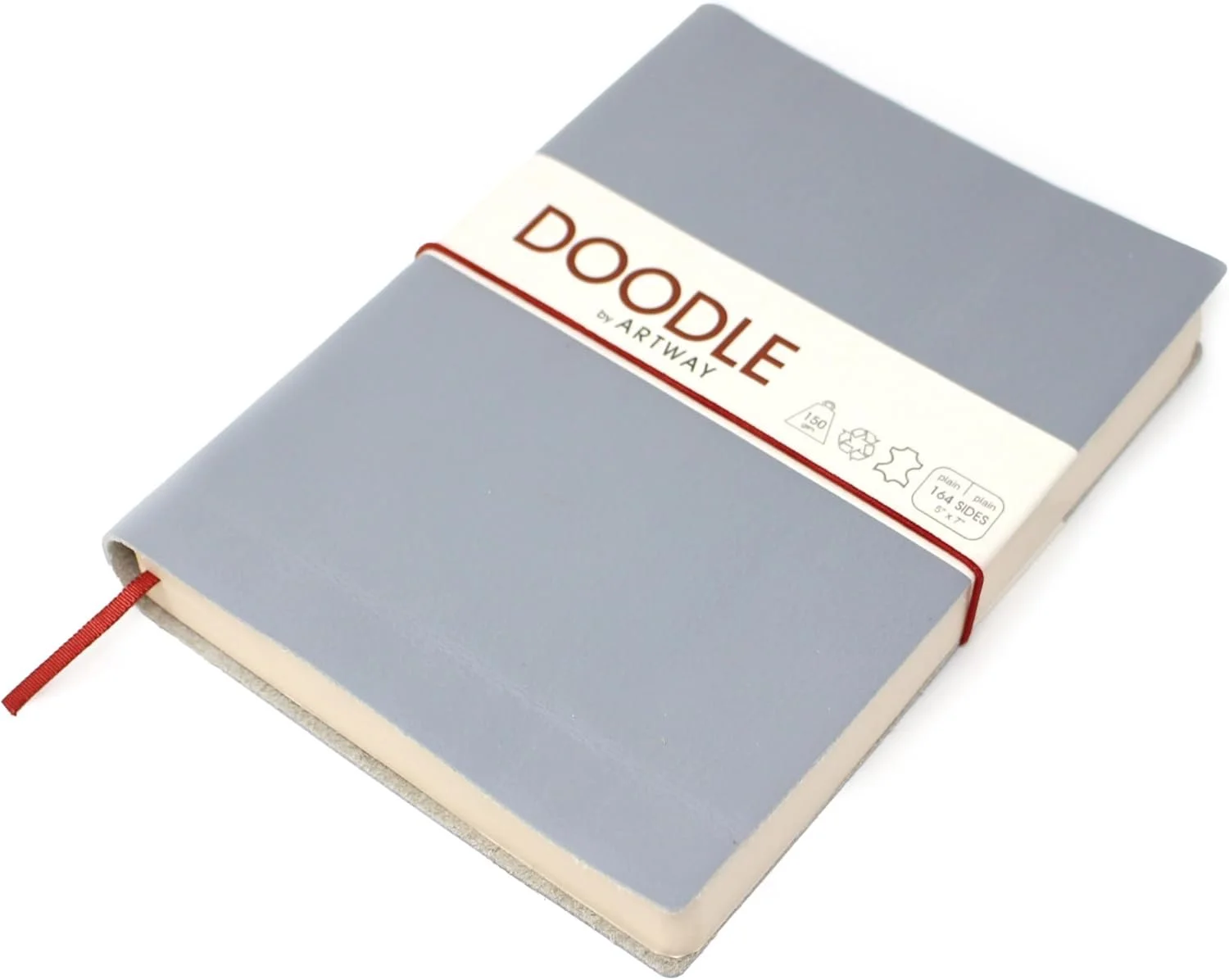
Soft cover multi-use Sketchbook and Journal - try to find one with at least 120gsm cartridge paper.
Continuity without compliance
The principle underneath patchwork journalling is what I think of as continuity without compliance.
I want a practice I can return to, not a routine I must obey.
Continuity does not have to mean doing the same thing every day. It can mean returning to the same book across a season, a year or several years. A holiday might fill twenty pages, while the following month produces only two small squares. Both belong to the same continuing record.
There is no catching up. I do not need to explain an absence or fill the missing dates. I can simply open the next available patch and begin again.
For someone who loves routine but rebels against imposed routines, this distinction matters enormously. The journal provides a little structure and a place to return to, but it does not demand performance.
There are no rules
Patchwork journalling isn’t a particular type of notebook, layout or artistic style. You can use a dot-grid journal, a sketchbook, loose sheets of paper kept in a ring binder, or whatever you already have.
Your patches can be squares, rectangles, hexagons or completely irregular shapes. You can write, collage, paint, draw, doodle, stamp, stick things in, add photographs, save scraps or simply make a mark. You can fill several patches at once or leave the page untouched for weeks.
There is no correct way to make a patchwork journal. The framework is there to make starting easier, not to give you another set of rules to follow. Use the parts that help and ignore the rest.


A deliberately small starter kit
Patchwork journalling does not require an enormous collection of specialist supplies.
In fact, too much equipment can create another barrier. If journalling requires setting out half a craft room, it becomes much harder to begin.
A simple kit might contain:
One sturdy A5 notebook
One comfortable writing pen
An ordinary wooden pencil
A small ruler
Scissors
A tape runner or glue stick
A few stickers
A limited selection of coloured pencils or pens
A small pouch or envelope for collected scraps
Start with one patch
If a whole blank page feels intimidating, do not begin with the whole page.
Draw one small box. Place down a template, add a photograph or stick in one scrap of paper. Write a sentence if you have one. Stop there if you want to.
You have not made an inadequate journal page. You have completed one patch.
The next patch might arrive tomorrow, next month or on a train somewhere in France. It can look completely different. There is no imposed aesthetic to maintain and no system to follow perfectly.
You do not have to become someone who journals every day.
You only need somewhere to put the things you want to remember when the impulse appears.
One sentence, one sticker or one slightly wonky square is enough.